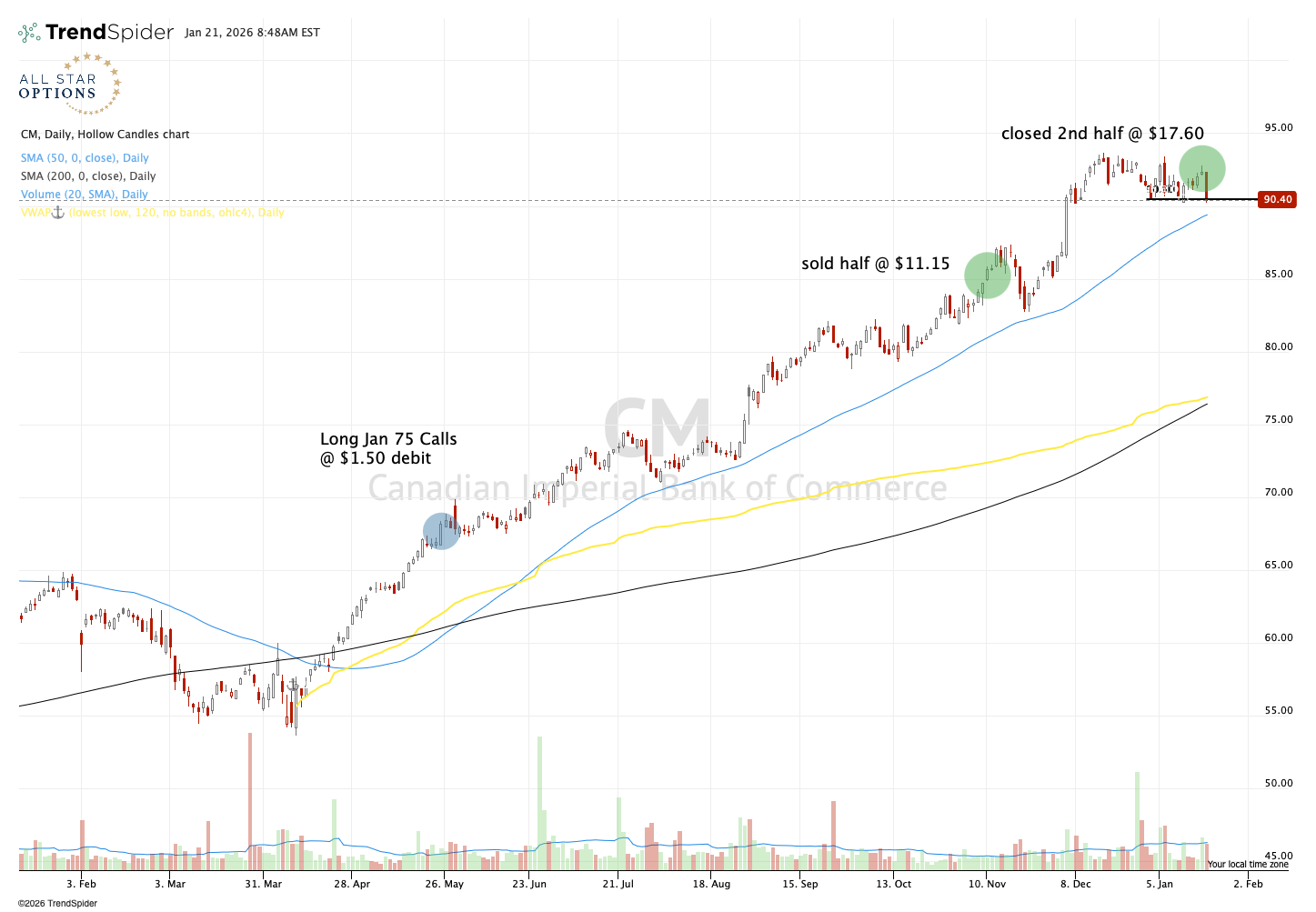
We've got blue skies above, with no resistance to worry about. But our old friend Fibonacci suggests the 86 level might offer a natural place to check the rally. As such, I'll sell half of my position if we get to $85 per share, and I'll hold the rest to see if we can be surprised.
My hopeful plan when getting in was to sell half if the stock got to $85. That was about the extent of my expectation.
Turns out, I was able to ride this position all the way to expiration day as the stock continued climbing well beyond that $85 level.
The real lesson here is about trendfollowing.
When you're trendfollowing—and I consider myself a trendfollower—you're served best by having no expectations and letting the market tell you when to get out.
This means I'll rarely, if ever, get out at the top. I'll leave gains on the table. But if the market doesn't signal an exit, there's no reason to get out.
Because you never know how far it'll go.
Sure, I might not nail the top. But trendfollowing is the only mindset that allows me to sell on the way down from a very high top.
You've gotta get there first.
I followed my plan—sold half at $85 to lock in gains and reduce risk. Then I held the rest and let the trend tell me what to do next.
Luckily, there was never a signal to exit. The stock kept trending higher. I trailed stops as it moved, gave it room to breathe while protecting gains, and stayed in until expiration day when the calls were about to expire.
That remaining half delivered far more than I expected on day one.
That's the discipline of trendfollowing. You don't predict where it ends. You follow until it stops going in your direction..
The $CM trade started with modest expectations—maybe we get to $85. It ended with the stock significantly higher than that initial target, and me holding calls to expiration day that delivered far more than I thought possible on day one.
This is what happens when you let winners run. When you don't cap your upside based on what you think "should" happen. When you trust the trend more than your predictions.
I entered with a plan and a stop. But the plan wasn't rigid. It adapted as conditions evolved. The market kept trending, so I kept following.
That's how you turn good trades into great ones.
Not by calling tops. Not by taking profits at predetermined levels just because they seemed reasonable when you entered. But by following the trend until it clearly breaks.
Did I leave money on the table by not selling the entire position at the absolute high? Of course. I always do. That's the cost of trendfollowing.
But I captured far more of the move than I would have with rigid profit targets based on my initial expectations.
The market doesn't care what I expected. It does what it's going to do. My job is to follow it, not predict it.
$CM reminded me why I trade this way. Modest expectations, flexible execution, let the trend run as long as it wants to run.
Sometimes it surprises you.
Sean McLaughlin | Chief Options Strategist, All Star Charts
--> If you'd like to receive these notes in your email, sign up here.