
30 Days That Rewired Global Finance

Yesterday I told you that S&P Dow Jones Indices licensing the S&P 500 to a decentralised exchange was the biggest structural shift in financial markets since electronic trading replaced the open outcry pit.
Today, JPMorgan published a research note telling its institutional clients the exact same thing.
This has gone through their managing director's desk telling every hedge fund, pension allocator, and sovereign wealth fund on their coverage list that non-crypto traders are migrating to Hyperliquid to trade oil through perpetual futures because traditional markets are simply closed when the world needs them most.
And the language they used is what really got me. They said this traction is likely to grow over time and extend beyond commodities to other assets. They said decentralised exchanges are exploiting a gap in traditional markets. They described Hyperliquid's onchain order book, sub-second finality, and portfolio margining as features of a professional-grade trading venue. JPMorgan is describing a DeFi protocol the way they describe Goldman's electronic trading desk.
Now let me connect this to the sequence of events I've been laying out, because the speed at which this thesis is validating is something I genuinely have not seen before in my career.
- On February 18th, Hyperliquid opened a $29 million policy centre in Washington DC and told Congress they were coming for a seat at the table.
- Ten days later, US and Israeli missiles hit Iran on a Saturday, oil spiked, every traditional exchange on the planet was closed, and Hyperliquid's oil contract exploded. The Wall St Journal covered it as the moment crypto became the world's weekend trading desk.
- Three days after that, CFTC Chairman went on stage and said the US would have a regulatory framework for perpetual futures within a month, explicitly stating that the previous administration drove this activity offshore and that America needs to recapture the liquidity.
- By March 10th, Hyperliquid's oil market hit $1.2 billion in open interest, and only 7 of the top 30 markets were crypto pairs. The rest were oil, gold, silver, equities, and indices. This is no longer a crypto exchange but rather a global derivatives venue that happens to settle on a blockchain.
- Then on March 18th, S&P Dow Jones Indices officially licensed the S&P 500 to Trade[XYZ] on Hyperliquid. The most important equity benchmark in human history went 24/7 on a decentralised chain.
- And the very next day, JPMorgan published a research report telling their institutional clients that all of this is real, it's structural, and it's going to grow.
That's 30 days.
Thirty days from opening a lobbying office in Washington to having the largest bank in America validate your existence in a note distributed to the most powerful capital allocators on Earth.
To put this in context: when electronic trading started replacing the pits in the 1990s, it took nearly a decade for major institutions to acknowledge the shift. When dark pools emerged, it took years of academic papers and regulatory hearings before Wall Street fully accepted they were reshaping market structure. Hyperliquid went from "interesting DeFi experiment" to "JPMorgan research coverage" in months.
And here's the part that nobody is talking about.
The JPMorgan report specifically notes that traditional exchanges are scrambling to catch up. CME is launching 24/7 crypto futures in May. Nasdaq is targeting 23-hour weekday equities trading in the second half of this year. NYSE is developing a tokenised asset platform. Cboe has proposed near-24/5 equities trading. But the report also notes that none of these traditional venues offer perpetual futures or the leverage that decentralised exchanges provide.
They're currently bringing a bicycle to an F1 race.
Think about what that actually means in practice. CME is going to offer you 23 hours of trading, five days a week, on standardised contracts with fixed expiry dates on infrastructure built in the 1990s. Hyperliquid is offering you 24 hours a day, 365 days a year, on perpetual contracts that never expire, settled instantly in stablecoins, with portfolio margining, accessible from a browser, no intermediaries, no prime broker, no clearing member, using officially licensed S&P 500 index data from S&P Global.
And JPMorgan just told the world that the second option is winning.
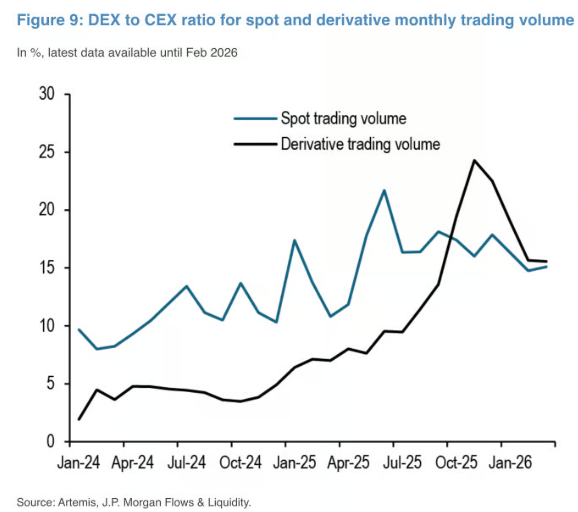
The only question left is how long it takes for every other traditional asset class to follow, and I think the answer is less time than anyone expects.
We're not in the "this will never work" phase. We're not in the "it works but it's niche" phase. We're in the "JPMorgan is writing research notes about it" phase. The next phase is every prime brokerage in New York asking how to connect to it. After that comes the phase where your retirement fund has exposure to markets that settle on a blockchain and you don't even know it.
Four days ago I said pay attention.
Today JPMorgan said the same thing, just in a fancier font.
The future of finance isn't coming.
It arrived, and it's running 24/7.
Cheers,
Louis Sykes
Senior Crypto Analyst, All Star Charts