
The Most Boring People in Finance Are Projecting a 1,000x Gain

Larry Fink published his annual letter yesterday. He's the CEO of BlackRock, the largest asset manager on the planet, north of $11 trillion under management. Every year he writes one of these and every year it tells you where the biggest money in the world is pointing.
This year he put tokenization front and centre.
So let's talk about what that actually means, because I think a lot of people hear the word and their eyes glaze over.
When you buy a share, that transaction passes through a stack of intermediaries: brokers, clearinghouses, custodians, settlement systems.
If you're buying Apple you don't think twice about it. But underneath, settlement still takes a day, markets close on weekends, and every intermediary in the chain posts collateral to cover the risk during the gap between when your trade executes and when it actually settles. Most of the time you'd never notice. Then something like GameStop happens and Robinhood has to freeze trading because the DTCC demanded billions in extra collateral overnight and the plumbing couldn't keep up.
Tokenization puts those assets onto blockchain rails, settlement becomes instant, and markets don't close. It's just simply upgrading the pipes.
What matters is who's now saying it.
- The NYSE is building a tokenized securities platform.
- Nasdaq has filed with the SEC to tokenize every listed stock.
- The DTCC is creating blockchain-based digital twins of securities it already holds.
- Robinhood, Coinbase, and Kraken are already offering tokenized stocks.
The market for tokenized equities went from $32 million to nearly a billion in a single year.
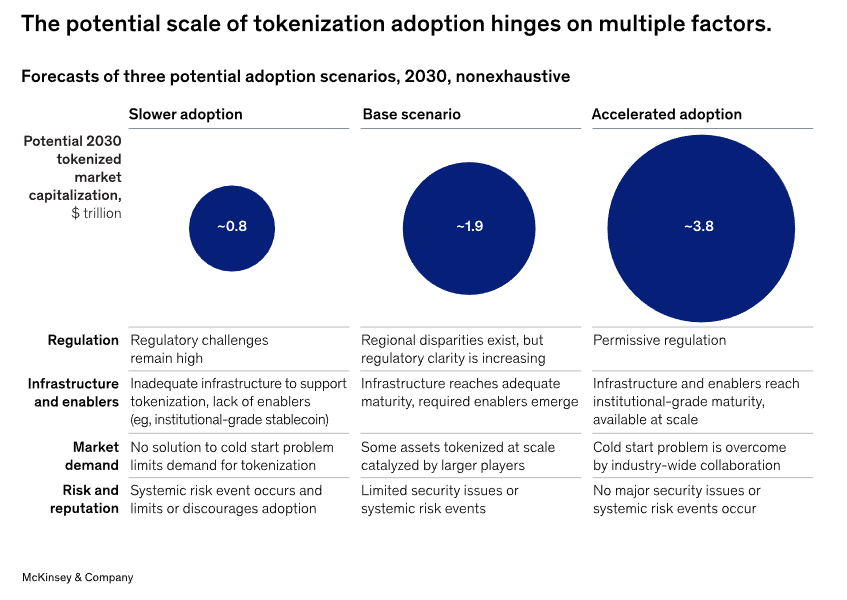
The institutions that run the current system are the ones rebuilding it. McKinsey projects $2-4 trillion in tokenized assets by 2030. Citigroup says $5 trillion. Standard Chartered, on the more extreme ends, says $30 trillion by 2034.
These are some of the most conservative institutions in finance and they're projecting a 1000x increase in tokenized assets within five years.
Fink framed it around inequality, because since 1989, a dollar in the US stock market has grown more than 15x the value of a dollar tied to median wages. His argument is that modernising the infrastructure, making it cheaper and more accessible, is part of how you close that gap. Half the world already carries a digital wallet. Imagine if they could invest through it as easily as sending a payment.
24/7 stock trading is coming. Not as a concept or as an academic whitepaper. The NYSE is building it and the Nasdaq is filing for it.
I spoke today with an institutional crypto data provider, a company valued in the billions that supplies the data behind S&P Global's crypto indices. The conversation was about exactly this. Tokenized securities infrastructure, institutional adoption, the plumbing that nobody on Twitter or the media is talking about.
The price action in crypto right now looks boring. What's happening underneath the surface is anything but. The largest financial institutions on earth are rebuilding the entire backend of the stock market on blockchain rails.
In a couple of years this will be all anyone in the industry wants to talk about.
Remember where you heard it.
Cheers,
Louis Sykes
Senior Crypto Analyst, All Star Charts