One of the biggest lessons I've learned over the years is that no market moves in isolation.
Just because you trade stocks doesn't mean you can ignore what's happening in bonds, currencies, or commodities.
Everything is connected.
For my timeframe, I pay close attention to the bond market—not because I actively trade bonds, but because it tells me a lot about the broader macro environment.
In fact, it's almost impossible for me to talk about stocks without bringing bonds into the conversation.
The bond market is simply too big and too important to ignore.
And while it has been relatively quiet over the past few years, stocks have gone on to produce one of the strongest rallies in recent memory.
But that quiet environment may not last much longer.
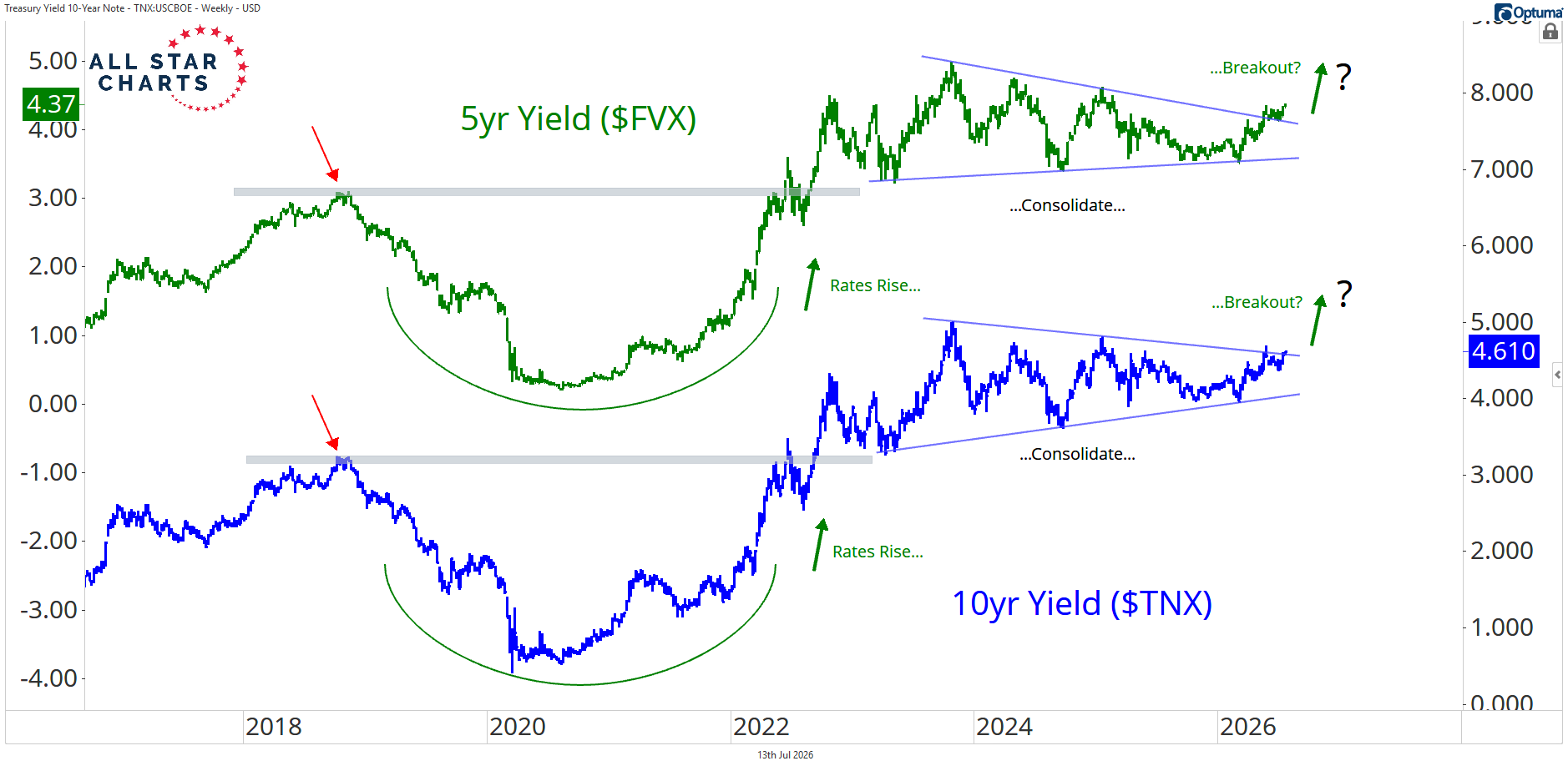
Both the U.S. 10-Year Treasury Yield and the U.S. 5-Year Treasury Yield are approaching the apex of large consolidation patterns.
That kind of compression rarely lasts forever.
Eventually, one side wins.
Here's the part I think many investors overlook.
It's rarely the direction of interest rates that matters most.
It's the rate of change behind that move.
Put simply, stocks tend to prefer a quiet bond market.
The lower the volatility in rates, the more comfortable investors are embracing risk.
But when that starts to change, every asset class pays attention.
A breakout in yields wouldn't just matter for bonds.
It would have implications for stocks, currencies, commodities, and virtually every major market around the world.
That's why I'm watching this so closely.
I'm less interested in predicting which way yields ultimately break.
I'm more interested in being ready for the environment they create.
Because if the bond market finally wakes up after years of moving sideways, I think we'll be looking at a whole new set of winners and losers.
Before I wrap up, I want to invite you to Grant's free live session on Wednesday, July 15, at 8:00 PM ET. He'll walk through the exact process he uses to narrow hundreds of charts down to just a handful of high-conviction trade ideas.